
If I want AI skin progress analysis to work in clinic, I need one thing above all: consistency. The software can track changes in wrinkles, redness, pigmentation, pores, texture, symmetry and skin age – but only if consent, photos, baseline notes and review dates are handled the same way every time.
In simple terms, this article shows me how to use AI skin analysis safely in day-to-day practice:
- Get clear consent for photography, facial data processing and storage
- Use the same photo setup each time: no make-up, tied-back hair, neutral face, fixed lighting and fixed views
- Record a proper baseline with AI scores, clinician notes, goals, skin type and treatment plan
- Review at the right interval: monthly for peels and skin boosters, 8–12 weeks for collagen-focused treatments, and 3–6 months for PRP-style plans
- Read AI results with the clinical picture, not on their own
- Keep governance tight with audit logs, restricted access and clear record retention rules
A few numbers stand out. Some AI-led treatment tracking reports show 31% to 45% reduction in hyperpigmentation, while one microneedle radiofrequency group showed skin improvement in 84%+ of cases. But the message is simple: AI is there to support my judgement, not make the treatment decision for me.
Quick comparison
| Area | What I need to do | Why it matters |
|---|---|---|
| Consent | Get explicit permission for photos and AI processing | Facial landmark data may count as biometric data |
| Imaging | Use the same angles, lighting and pose at each visit | Cuts down false change between appointments |
| Baseline | Log AI scores, skin age, personalized skin consultations and patient goals | Gives me a clean starting point |
| Review timing | Match reviews to treatment type | Makes progress checks more useful |
| Interpretation | Compare scores with exam findings and patient feedback | Stops over-reliance on software output |
| Governance | Keep secure storage, logs and access controls | Supports safe record handling |
If I keep the workflow fixed from the first visit onwards, AI progress analysis becomes far more useful for treatment review, patient communication and clinic record-keeping.
sbb-itb-4219cc3
Build an AI-ready consultation workflow
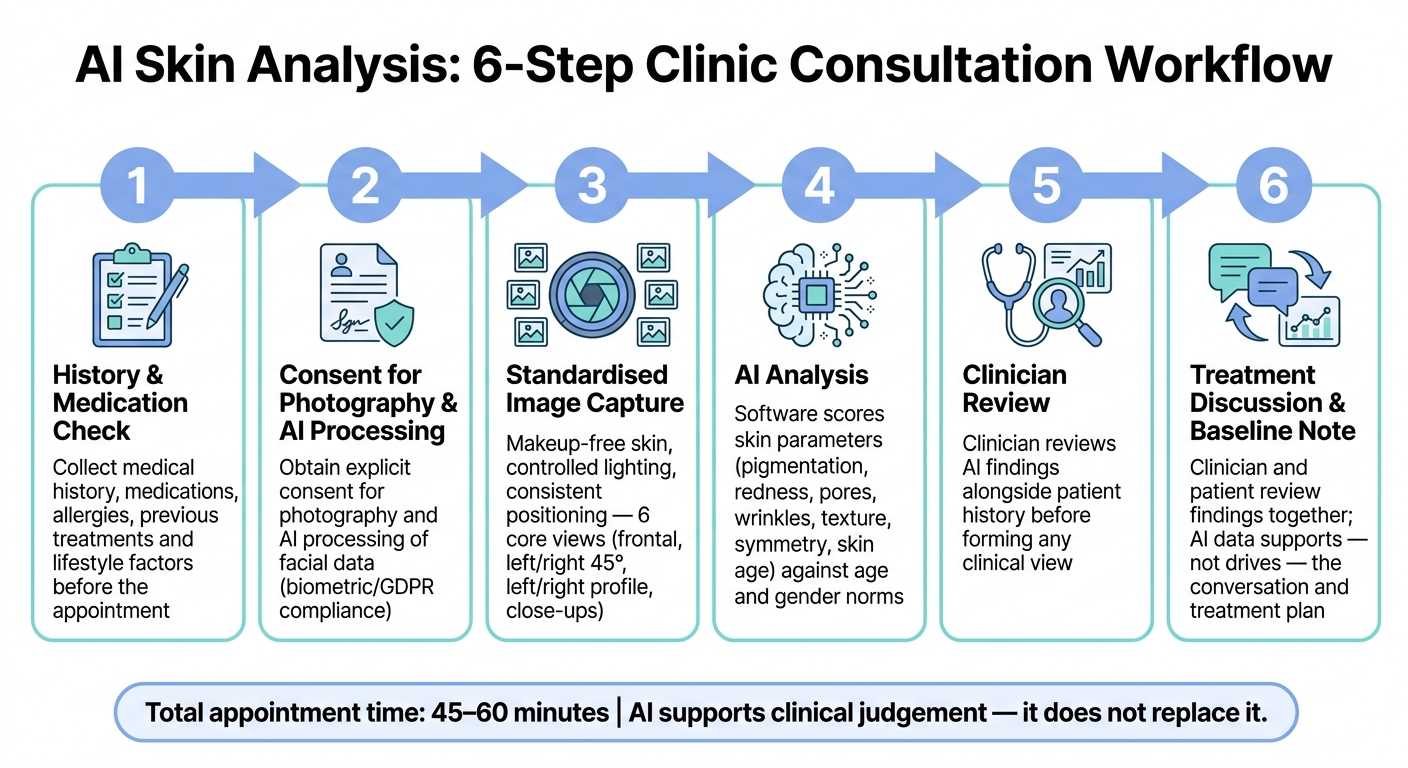
AI Skin Analysis Clinic Workflow: 6-Step Consultation Process
AI works best when consent, imaging and review sit inside one fixed clinic process.
Fit consent, imaging and AI review into a standard appointment
Set aside 45 to 60 minutes for the first AI consultation.
That appointment usually follows six clear stages:
| Stage | What Happens |
|---|---|
| 1. History and medication check | Medical history, current medications, allergies, previous treatments and lifestyle factors are collected before the appointment begins |
| 2. Consent for photography and AI processing | Explicit consent is obtained for photography and AI processing of facial data |
| 3. Standardised image capture | Standardised photos are taken with makeup-free skin, controlled lighting and consistent positioning |
| 4. AI analysis | Software scores skin parameters against age and gender norms |
| 5. Clinician review | The clinician reviews AI findings alongside the patient’s history before forming any view |
| 6. Treatment discussion and baseline note | Clinician and patient review findings together, with AI data used to support – not drive – the conversation |
This order matters. If images are taken one way on day one and another way six months later, the comparison starts to fall apart. A fixed process keeps the baseline clean and makes later reviews more useful.
Facial landmark data counts as biometric data under GDPR, so get explicit consent and explain how the data will be stored and used.
AI supports clinical judgement. It does not replace it.
Once the workflow is fixed, the clinic can compare future visits against a reliable baseline.
Assign roles to reception, imaging staff and the reviewing clinician
Clear ownership helps the whole appointment run smoothly:
- Reception collects history and consent.
- Imaging staff capture consistent photos.
- The clinician reviews AI scores alongside the patient’s history and treatment goals.
Named owners make audits easier and strengthen clinical governance.
This workflow creates the baseline that later reviews will measure against.
Standardise image capture and baseline records
A reliable baseline is the starting point for every AI comparison. If you capture it under different conditions each time, even small shifts can look like skin change when they’re not. That’s why consistency matters so much. Once image capture is locked down, record the baseline data that future visits will be judged against.
Use the same views, lighting and positioning at every appointment
Use six core views at each appointment: frontal view, left and right 45-degree angles, left and right profile views, and close-ups of any specific concern areas.
Set up the patient the same way every time. Hair should be tied back. No make-up. Neutral expression. No filters. Keep room lighting consistent, and where possible use lighting-normalisation software so skin tone is shown accurately.
Pose correction also helps keep facial landmarks aligned. When those conditions stay fixed, the baseline data is far more dependable for follow-up review.
Record baseline skin scores and treatment context
Don’t stop at images. Before treatment starts, document:
- AI-generated scores, estimated skin age and the clinician’s own assessment
- The patient’s main concerns and treatment goals
- Dates in UK format (DD/MM/YYYY)
- Planned products or devices
- Relevant medical factors, including age, gender, and Fitzpatrick skin type
Record ethnicity and Fitzpatrick skin type as well, so scores are read in the right context.
Taken together, the AI scores, clinician assessment and patient goals form the data set used at every later review point.
Minimal versus full imaging protocol: comparison table
| Feature | Minimal Imaging Protocol | Full AI Imaging Protocol |
|---|---|---|
| Views taken | Frontal and profiles only | Front, 45° angles, profiles and close-ups |
| Lighting control | Standard room lighting | Multi-spectral (UV, RGB, cross-polarised) |
| Calibration method | Manual visual alignment | AI-guided pose correction and landmark anchoring |
| Metadata captured | Name, date and basic concern | Age, gender, ethnicity and skin type (Fitzpatrick) |
The minimal protocol is a decent place to start, but it limits what the AI can compare with confidence later on. A full protocol, especially one that uses multi-spectral imaging, gives the software more to work with. It can separate melanin from haemoglobin and spot subsurface UV damage. The key is to stick with the same protocol at every follow-up, so any visible change comes from treatment rather than differences in image capture.
Set review points and track progress safely
Once the baseline is locked in, the review schedule should match the treatment.
Choose review intervals by treatment type and skin concern
For peels or skin booster courses, review every month. That gives you enough time to spot early changes in texture and barrier function.
Collagen-stimulating treatments, such as microneedling or laser resurfacing, need more patience. An 8–12 week comparison is usually the right window if you want to see the full effect.
Injectables, including anti-wrinkle injections and dermal fillers, should be reviewed in line with the usual treatment cycle. That makes it easier to assess volume changes and left-right balance.
PRP and longer-term rejuvenation programmes often need a 3–6 month window before you can judge the full response.
For maintenance, review once or twice a year. If the patient has swelling, redness or irritation, wait until the skin has settled before re-imaging.
Once you’ve set the interval, stick with the same metrics at every follow-up.
Monitor the right metrics at each follow-up
At each review, read the AI data alongside the physical examination and the patient’s own feedback. Redness, texture and pigmentation should always be checked against what you can see in clinic and what the patient reports.
AI should support the review, not replace clinical judgement.
If the numbers start heading the wrong way – say texture scores drop or pigmentation gets deeper – flag it for clinician review before the next session. Think of AI as a guardrail. It helps you spot drift early and avoid overcorrection.
Those results should then feed straight into treatment planning and governance.
AI metrics interpretation table
The table below sums up common follow-up metrics, what they measure, what progress may look like, and the sort of action they can prompt.
| Metric | What It Measures | Improvement Sign | Clinical Follow-up Action |
|---|---|---|---|
| Pigmentation/UV spots | Melanin clusters and subsurface sun damage | Lightening of spots; higher percentile score | Continue or adjust laser/peel protocol |
| Vascularity/Redness | Haemoglobin levels and capillary fragility | Reduction in red areas and erythema | Confirm barrier recovery before proceeding |
| Pore visibility | Size, count and distribution of pores | Reduced diameter and density | Refine skin-quality scoring or microneedling depth |
| Wrinkle depth | Line density and shadow-depth patterns | Softening of lines; reduced depth | Review neurotoxin dosage or filler placement |
| Texture/Roughness | Surface smoothness and peak-to-valley variance | Lower roughness score; improved uniformity | Adjust exfoliation or skin booster frequency |
| Symmetry | Alignment of 68+ facial landmark points | Improved left-right balance | Refine filler placement in subsequent sessions |
| Skin age | Biological versus chronological skin indicators | Skin age score falling over time | Use as a motivational benchmark for patient retention |
Targeted interventions guided by AI analysis can reduce hyperpigmentation by 31% to 45%. Microneedle radiofrequency treatments tracked in this way also showed measurable improvement in pigmentation and hydration in over 84% of cases.
Use the same capture protocol at every review.
Use these trends to decide whether to proceed, pause or adjust treatment.
Use AI findings to support safe treatment planning and governance
Turn progress data into safer treatment decisions
Once the review data is in, the next step is simple: use it to guide treatment. AI gives clinicians measurable, repeatable data, which helps cut down the guesswork that can come with visual checks alone.
Shifts in wrinkle depth, pore size and pigmentation scores can show whether a treatment plan is on track. At the same time, rising vascularity or falling hydration can warn that a change is needed. That might mean pausing peels if redness goes up, or delaying microneedling if hydration drops. AI can also pick up UV damage and vascular change before they can be seen with the naked eye.
Use AI scores to help decide whether to continue, pause or adjust treatment. But the final call should stay with the clinician.
After that comes governance: keeping the data safe and making sure access is controlled.
Put consent, privacy and audit controls in place
Get clear consent for AI analysis, and separate consent for any marketing or education use. Patients should know how their images will be stored, who can see them, how long records will be kept, and what happens if they ask for deletion.
When choosing a tool, ask whether it has been tested across diverse Fitzpatrick skin types to help cut bias. The main governance controls are secure storage, clear consent tracking, audit logs and clinician review:
| Governance Area | What to Put in Place |
|---|---|
| Secure storage | Use end-to-end encryption for patient imagery at rest and in transit |
| Consent tracking | Integrate digital sign-offs into the software workflow before analysis begins |
| Audit logs | Keep a record of who accessed or modified a patient record, and when |
| Dataset transparency | Use models validated across diverse Fitzpatrick skin types to reduce bias |
| Clinician review | Qualified clinicians should interpret AI outputs alongside history and goals |
England licensing rules now also apply to non-surgical cosmetic procedures. In day-to-day use, AI should be treated as decision support. The clinician reviews the report, explains the findings in plain English, and makes the final treatment call.
These checks help keep AI useful without weakening clinical oversight.
Conclusion: A practical model for clinics in Bristol, Bath, Cardiff and nearby areas
Structured AI skin progress analysis works best when the process stays consistent: clear consent, standardised image capture, accurate baseline records, scheduled review points and clinician-led interpretation of the findings. Used well, AI supports safer, clinician-led treatment planning for clinics in Bristol, Bath, Cardiff and nearby areas.
FAQs
Is AI skin analysis accurate enough for treatment reviews?
Yes. AI skin analysis is highly accurate for objective measurements and for tracking progress over time. In many cases, it’s more consistent than visual assessment alone.
It helps clinicians record baselines and monitor changes in wrinkle depth, pigmentation, and pore size. But it’s a decision-support tool, not a replacement for clinical judgement. Results should always be interpreted by a qualified practitioner.
What photos do clinics need for reliable AI skin tracking?
Clinics need high-resolution, standardised clinical photos so they can show actual skin changes, not shifts caused by lighting, distance, or camera angle.
That means keeping a few things the same every time: lighting, camera-to-subject distance, and the set of views taken. In most cases, clinics use multiple angles, usually frontal, left lateral, and right lateral.
Some systems go further. They may use lighting normalisation, pose correction, and multi-spectral imaging, including UV and cross-polarised light, to make image comparison more reliable.
How often should AI skin progress reviews be done?
For solid progress tracking, most experts suggest AI skin analysis reviews every 3 to 6 months. That gives you a clear way to monitor changes and adjust your treatment plan as your skin shifts over time.
For general upkeep, an annual or bi-annual assessment usually does the job. It also helps to book a scan before starting a major new treatment, or after finishing a course of professional skin therapy, so you can assess your results with a more objective view.