
Laser hair removal does not mean hair never comes back. After a first course of 6–8 sessions, many people see about 80–90% long-term hair reduction, but some regrowth is still normal.
If I want the short answer, it’s this:
- Face and neck often need top-ups every 6–12 months
- Chin and jawline may need top-ups every 3–4 months if hormones are a factor
- Underarms, legs, arms, back and chest often need top-ups every 12–24 months
- Bikini/Brazilian often sits in the middle at 12–18 months
- Shaving is fine between sessions
- Waxing, plucking and threading are not
- Sun and fake tan should be avoided for 2 weeks before and after treatment
- Top-ups are usually single sessions, so yearly costs depend on the area treated and how much regrowth I get
What changes the plan? Mainly the body area, hair cycle, and hormones. Facial areas like the upper lip, chin and jawline often need more follow-up than body areas. Hormonal changes linked to PCOS, pregnancy, perimenopause or menopause can also make regrowth show sooner.
I’d also keep an eye on how the hair comes back. If it starts looking darker, coarser or more spread out, or facial hair returns with symptoms like irregular periods or acne, it’s worth speaking to a clinician or GP.
| Area | Usual top-up timing | Notes |
|---|---|---|
| Upper lip / chin / jawline | 6–12 months | May be 3–4 months with hormone-led regrowth |
| Underarms | 12–24 months | Often low upkeep |
| Bikini / Brazilian | 12–18 months | Mid-range upkeep |
| Legs | 12–24+ months | Often less frequent |
| Back / chest / arms | 12–24 months | Often steady after the first course |
So when I think about maintenance, I’d treat it as a long-term reduction plan, not a fixed promise of permanent removal. The aim is simple: book top-ups when regrowth is visible and worth treating, then review the pattern over time.
How laser hair removal upkeep works
Upkeep comes down to hair cycles, hormones and the area treated after your first course. Laser hair removal works best on hairs in the active growth phase, which means only some follicles are hit in each session. So upkeep is based on regrowth, not a fixed end point.
Why some regrowth is normal
Some follicles stay dormant for months or even years, then switch back on. Because of that, maintenance sessions are sometimes needed. When regrowth shows up, it is usually finer, lighter and sparser than before. The laser weakens the follicle’s ability to produce coarse hair, but it does not always stop every follicle for good.
Hormones can also play a big part here. Changes linked to pregnancy, PCOS, perimenopause, and menopause can stimulate dormant or partly damaged follicles.
When to review your results
Book a review if regrowth starts to look coarser, darker, or more spread out than you expected. It also makes sense to check in sooner after a major hormonal change.
The next section sets out typical maintenance intervals by area.
sbb-itb-4219cc3
Maintenance intervals and top-up schedules by treatment area
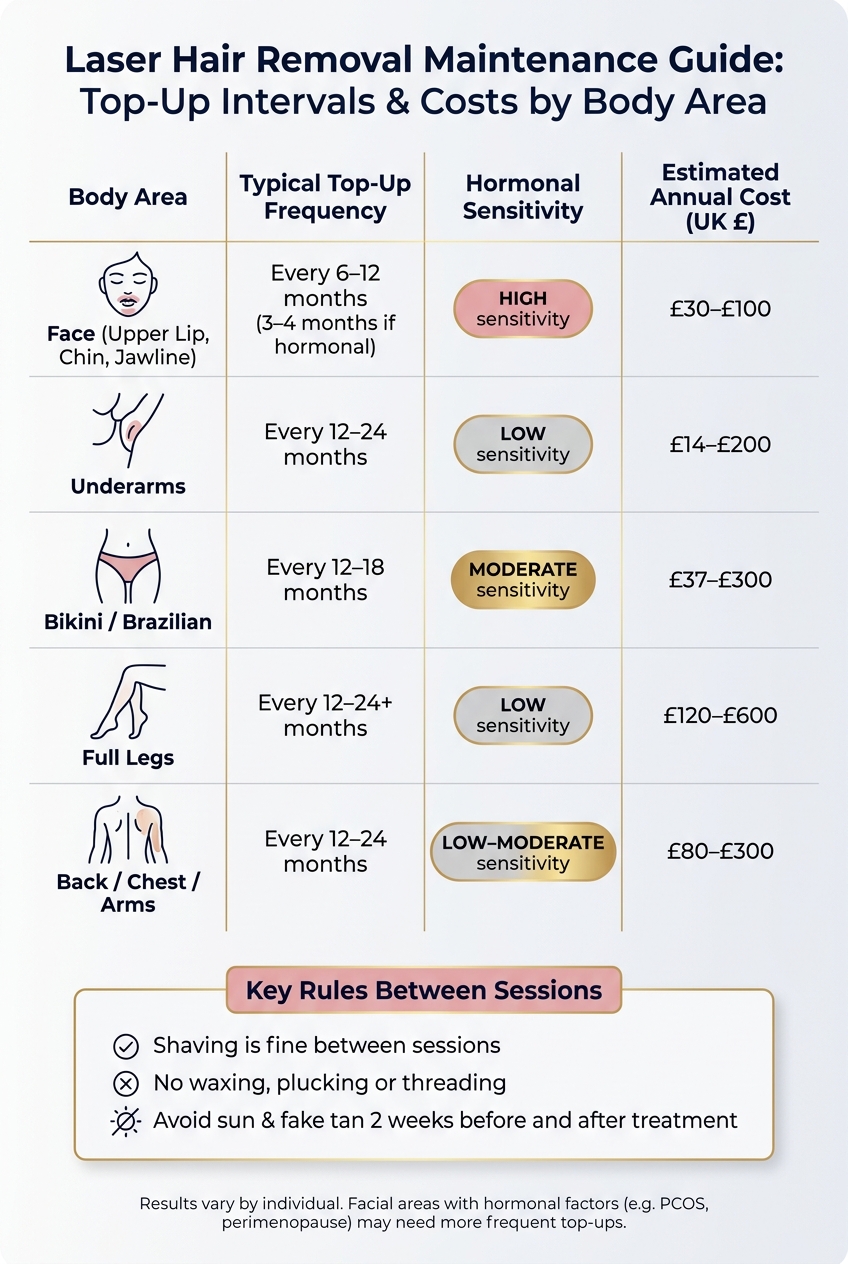
Laser Hair Removal Maintenance: Top-Up Intervals & Costs by Body Area
Once regrowth starts to show, the treatment area usually tells you how soon you’ll need a top-up. In most cases, timing comes down to the area itself and how strongly it responds to hormones. Use the intervals below as a starting point, then fine-tune them after each review.
Facial maintenance intervals
Face and neck regrowth usually needs the most upkeep. Areas like the upper lip, chin, jawline, and neck are closely linked to hormonal activity, so they tend to keep more dormant follicles than body areas. Most people need a top-up every 6 to 12 months after they finish their first course. These sessions are often shorter than the original set of treatments.
If hormonal shifts are part of the picture, such as PCOS or perimenopause, that window can shrink. For the chin and jawline, top-ups may be needed every 3 to 4 months.
Body maintenance intervals
Body areas usually need fewer top-ups. Underarms, legs, arms, back, and chest are less affected by hormonal fluctuation. Most people need a top-up every 12 to 24 months after finishing their course, and some areas can go even longer.
The bikini line and Brazilian sit somewhere between facial and body areas, with a usual maintenance interval of 12 to 18 months.
| Treatment Area | Typical Maintenance Interval | Hormonal Sensitivity |
|---|---|---|
| Face (Lip, Chin, Jawline) | 6–12 months (3–4 months if affected by hormonal changes) | High |
| Underarms | 12–24 months | Low |
| Bikini / Brazilian | 12–18 months | Moderate |
| Legs (Lower/Full) | 12–24+ months | Low |
| Back / Chest / Arms | 12–24 months | Low to Moderate |
Next, plan how those intervals affect your yearly top-up budget.
Areas that usually need the most upkeep
The upper lip, chin, jawline and neck usually need the closest follow-up of any treatment area. If one area is going to need more regular attention, it’s often one of these.
Cost planning and building a long-term routine
How to budget for top-ups over 12 months
Once you know the likely maintenance intervals, the next job is simple: turn them into a yearly budget that you can live with.
Top-ups are usually sold as single sessions, not bundles. That means they cost much less than your first course. A good way to plan is by treatment area. Then tweak the numbers based on your hair pattern and any hormone-led regrowth.
Prices can vary a lot from one clinic to another, so compare like for like. A cheap session on paper may not be the same in treatment time, area covered, or clinic standard.
Matching your routine to your hair pattern and schedule
Timing matters just as much as frequency. Try to book top-ups well away from summer holidays, and avoid tan, including fake tan, for two weeks before and after treatment.
Between sessions, shave if you need to. Skip waxing and plucking, because the laser needs the follicle to stay intact.
Maintenance plan comparison by area and frequency
Use the table below to match frequency and cost to each treatment area. Costs are general guidance and will vary by clinic, location, and individual response to treatment.
| Treatment Area | Typical Frequency | Estimated Annual Cost (£) | Notes |
|---|---|---|---|
| Upper Lip / Chin | Every 6–12 months | £30 – £100 | Shorter intervals if hormonal factors are present |
| Underarms | Every 12–24 months | £14 – £200 | Best long-term value per session |
| Bikini / Brazilian | Every 12–18 months | £37 – £300 | Mid-range frequency and cost |
| Full Legs | Every 12–24 months | £120 – £600 | Largest single-session cost; infrequent |
| Back / Chest | Every 12–24 months | £80 – £300 | Low hormonal influence; stable results |
Once you can see which areas cost the most to maintain, it becomes easier to set priorities. Put more of your budget towards high-hormone areas first, then top up body areas only when regrowth starts to show.
Common questions about laser hair removal maintenance
The answers below deal with the points clients ask about most: timing, shaving, holidays, and when regrowth should be looked at more closely.
Do you need maintenance sessions forever?
Not always. How often you need top-ups depends on the area treated and your hormonal profile.
Some clients need only a small number of sessions after their first course. Others, especially those treating hormonally sensitive facial areas, may need occasional sessions over a longer period.
How do you know when a top-up is needed?
Book a top-up when regrowth becomes visible or starts to bother you. If the hair is still fine and sparse, it’s usually better to wait a bit longer before booking.
Can you shave between maintenance sessions?
Yes – shaving is the only recommended method between sessions. Methods that pull hair from the root, such as waxing, plucking, threading, or epilating, should be avoided. The laser needs the follicle to stay intact to work as intended.
Should you avoid treatment before or after a holiday?
Yes. Recent sun exposure or tanning products can increase the risk of burns and pigmentation changes. If you have a trip planned, book your top-up well before you travel, or wait until any tan has fully faded.
When should facial regrowth be checked for hormonal causes?
If hair on the chin, jawline, or neck comes back quickly or starts to feel coarser, mention it to a clinician. If the change is sudden, or it comes with symptoms like irregular periods or adult acne, speak to your GP to check for a hormonal cause such as PCOS or menopause before booking more top-ups.
If facial hair keeps returning sooner than expected, the next section covers how to choose a clinic for longer-term upkeep.
Choosing a clinic for long-term maintenance
Once you know your maintenance pattern, the next step is picking a clinic that checks regrowth properly and handles top-ups in a steady way. Maintenance isn’t a one-off visit. It’s long-term care. That means the clinic should look at how your hair is changing over time, not just keep filling diary slots.
Questions to ask before booking a maintenance session
A few plain questions can tell you a lot about how a clinic handles long-term care.
Ask if the practitioner will check your regrowth before treatment instead of just copying the same settings from your last visit. Ask how the clinic prices one-off top-up sessions too. If a single session costs almost as much as a full course, that’s poor value for long-term upkeep.
It’s also worth asking whether the clinic keeps full treatment notes, including device settings, so your progress can be tracked over time. And if there’s been a long gap since your last session, ask whether you’ll need a new patch test. Good clinics will say yes, especially if your skin sensitivity may have changed because of age, medication, or lifestyle.
Also check that the practitioner has a Level 4 qualification in laser and IPL hair removal, which is the Ofqual-regulated standard in the UK.
Why personalised review matters more than fixed promises
A good clinic avoids blanket guarantees. Look for clinics that say "long-term reduction", not "permanent removal".
What counts is whether the clinic reviews how your hair is coming back. Coarse regrowth on the chin after a short gap is not the same as a few fine hairs on the leg after 18 months. Those are two different clinical pictures. If a practitioner treats both in the same way, they aren’t reviewing your results with enough care.
What to compare when looking at clinic follow-up options
When you’re comparing clinics, don’t look at price alone. Check the quality of the follow-up as well.
| Factor | What a good clinic does | What to watch out for |
|---|---|---|
| Terminology | Uses "permanent reduction" or "long-term reduction" | Promises "100% permanent removal" |
| Top-up pricing | Clear single-session rates (for example, lip/chin from £35, underarms from £55) | Only sells multi-session packages at inflated single rates |
| Consultation approach | Reviews regrowth pattern and any hormonal or medication changes before treating | Treats on a fixed, identical schedule whatever the hair density |
| Device suitability | Uses medically certified equipment matched to your skin type – Alexandrite for light skin, Nd:YAG for darker skin | Uses low-powered IPL or unnamed generic devices |
| Patch testing | Requires a new patch test after long gaps or changes in skin condition | Skips patch tests to speed up booking |
| Treatment records | Keeps steady notes on settings and areas treated over time | No record of previous sessions or device parameters |
Conclusion: building a realistic laser maintenance plan
Laser hair removal maintenance comes down to three things: the area treated, your hormones, and how your regrowth shifts over time. That’s why it helps to set a budget by area and review your costs once a year.
Use these final points to turn the guide into a simple upkeep plan.
Key points to remember
- Maintenance is normal because only some follicles are active at any one time. Dormant follicles can become active again months or years later.
- Facial areas need closer watching than body areas, especially if hormonal factors like PCOS or perimenopause are involved.
- Book when regrowth becomes visible or bothersome, not to a fixed timetable.
- Shave between sessions – never wax or pluck, as the follicle must stay intact for the laser to work effectively.
- Plan annually to keep costs predictable and make it easier to decide when a top-up is actually needed.
If your regrowth starts changing faster than expected, look for a clinic that reviews the pattern rather than just the calendar. For clients in Bristol, Bath, Cardiff, Swindon, Newport and Gloucester, Eternaface offers personalised laser hair removal consultations based on your regrowth pattern and maintenance needs.