
Laser hair removal can cut hair growth over time, but it does not remove every hair for life. If I were skimming this guide for the main points, I’d want these first:
- Most people need a course of sessions, because hair grows in cycles
- Dark, coarse hair usually responds best
- Blonde, red, grey and white hair often respond poorly
- A patch test is usually done at least 48 hours before treatment
- You should shave 12–24 hours before a session
- Waxing, plucking and threading should be avoided before treatment
- Short-term redness, warmth and mild swelling are common
- Cost in the UK depends on area size, hair density, skin type and session count
Put simply: the laser targets pigment in the follicle, heats it, and slows future growth. Because only some hairs are in the right growth phase at any one time, one session is rarely enough. Many people then book top-up sessions later to help keep results on track.
If I wanted a fast view of what this guide covers, it would be this:
| Topic | What you need to know |
|---|---|
| How it works | Light targets the hair follicle and turns to heat |
| Best candidates | People with a clearer contrast between skin and hair |
| Common areas | Face, underarms, legs, bikini line and back |
| Before treatment | Consultation, skin check and patch test |
| During treatment | Short pulses; often feels like heat or a snap |
| After treatment | Shedding is normal; aftercare matters |
| Cost | Set after consultation; often £ varies by area and session plan |
| Risks | Redness and swelling can happen; sun care matters |
A useful fact to keep in mind: at any given time, only a share of your hairs are in the active growth phase, which is why sessions are spaced out over weeks rather than done all at once. This guide also covers how clinics such as Eterna Face assess skin type, hair colour and treatment settings for people in Bristol, Bath, Cardiff, Swindon, Newport and Gloucester.
The Ultimate Guide to Laser Hair Removal – Pros, Cons & Aftercare!
sbb-itb-4219cc3
How Laser Hair Removal Works and What Results to Expect
Laser hair removal uses concentrated light that the pigment in the hair follicle absorbs. That light turns into heat, which damages the follicle.
What does that mean in plain English? The treatment aims to slow future hair growth by treating the follicle at the root.
Most people see long-term hair reduction after a full course of sessions. But the change doesn’t happen all at once. Results build over time because only follicles in the active growth phase respond to the laser. That’s why treatment is done as a course, not as a one-off appointment. You may also need maintenance sessions later on.
Hair Growth Cycles and Why Multiple Sessions Are Needed
Only follicles in the active growth phase respond to treatment, so sessions need to be spaced across several weeks.
Hair grows in cycles, not all at once. So at any given time, only some follicles are active. Each session treats a different share of hairs, which is why one appointment on its own can’t give lasting results.
Laser Types, Skin Tone and Hair Colour
Wavelength choice matters. The laser needs to target the follicle without overheating the skin around it.
When the wavelength is chosen well, it treats the follicle while lowering the risk of burns and pigmentation changes. Results tend to be best when there’s a clear contrast between the hair and the skin. Dark hair usually responds best. Blonde, red, white and grey hairs often respond poorly, or not at all.
That’s also why consultation and patch testing matter before treatment. They help check whether the treatment is a good fit for your skin tone and hair colour.
Laser Hair Removal vs IPL: Key Differences
Who Is Suitable and Which Areas Can Be Treated
Once you know how the laser targets the follicle, the next step is simple: work out whether your skin, hair and treatment area are a good fit.
Laser hair removal usually works best on dark, coarse hair and lighter skin, where there’s a clear contrast for the laser to pick up. It tends to be less effective on very light, red, grey or white hair. You also need to be careful if you’ve had recent sun exposure, have active skin irritation, or have a skin condition that affects the area being treated.
Common treatment areas include:
- Face
- Underarms
- Legs
- Bikini line
- Back
Smaller areas need more precision. Larger areas usually take longer per session.
Once suitability is confirmed, the consultation and patch test help set the right treatment settings.
Consultation, Patch Test, Treatment Sessions and Aftercare
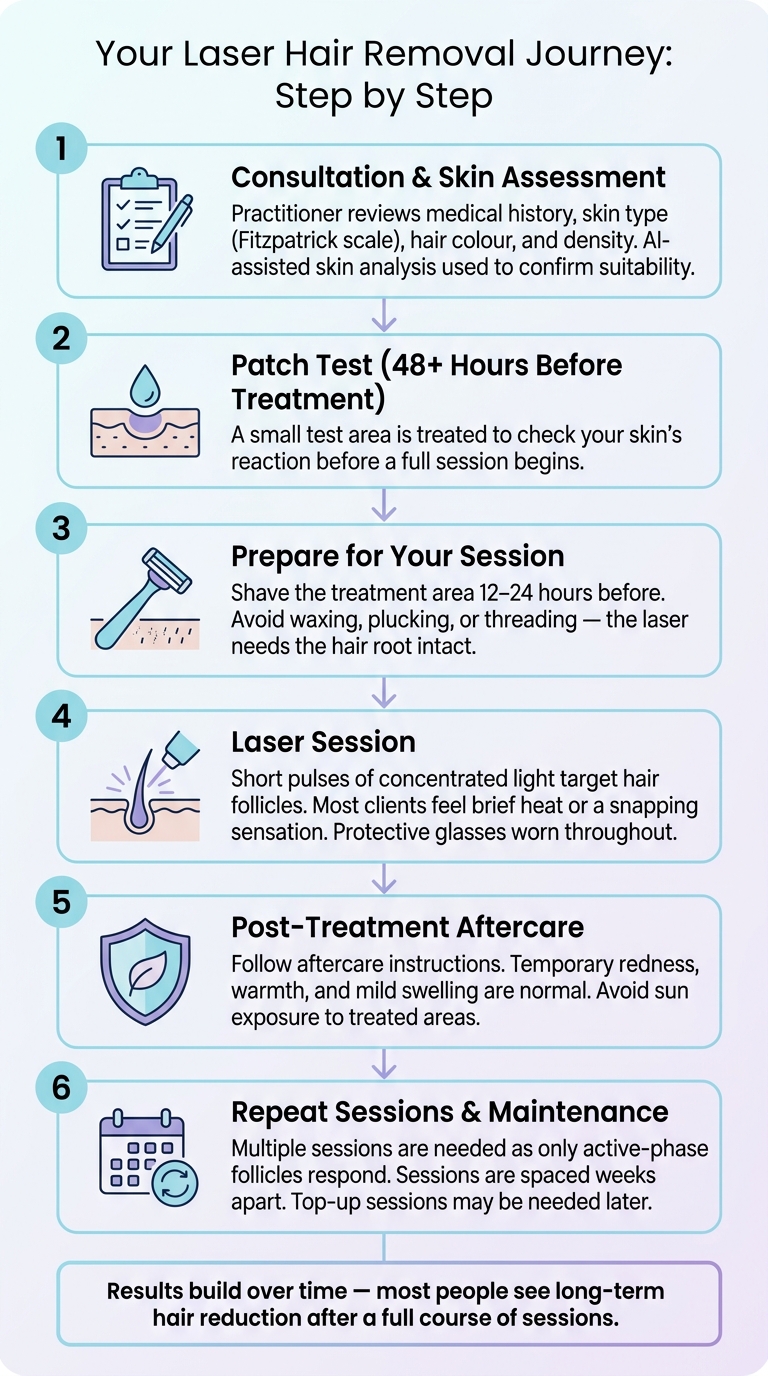
Laser Hair Removal: Step-by-Step Process Guide
Consultation and AI Skin Analysis at Eterna Face
Once suitability is confirmed, the next step is the consultation and patch test.
At your first appointment, the practitioner reviews your medical history, medication, skin type, and hair characteristics. From there, they set the safest laser settings for your treatment. At Eterna Face, practitioners use Fitzpatrick skin typing and check hair density and pigment to confirm whether your skin tone, hair colour, and treatment area are suitable for the course.
Eterna Face also uses AI-assisted skin analysis. This helps the practitioner choose the right settings for your skin type and treatment area for clients across Bristol, Bath, Cardiff, Swindon, Newport and Gloucester.
That assessment then guides both your patch test and your treatment settings.
Patch Testing, Preparation and What Happens During a Session
A patch test is usually needed at least 48 hours before your first full treatment session. It shows how your skin reacts before a full session starts, so it’s part of the safety process, not just a box-ticking step.
Before your appointment, shave the treatment area 12–24 hours in advance. Don’t wax, pluck, or thread beforehand, because the laser needs the hair root to work on. During the session, the laser is delivered in short pulses. Most clients describe the feeling as brief heat or a snapping sensation.
Aftercare, Hair Shedding and Booking Your Next Session
After the session, you’ll leave with clear aftercare instructions for the treated area. Shedding after treatment is normal. Your next session is then booked in line with your treatment plan.
Both of these are a standard part of hair reduction, not a sign that the treatment hasn’t worked. Your practitioner will also confirm the timing of your next session.
Costs, Risks, Comparisons and Final Summary
Once you know how laser works, the next things people want to know are simple: What does it cost? Is it safe? And is it better than shaving or waxing?
Typical UK Pricing and What Affects the Total Cost
UK pricing can change based on the treatment area, hair density, skin type, and how many sessions you need. The final price is confirmed after consultation.
That matters because laser hair removal isn’t usually a one-off appointment. A small area will often cost less than a large one, and thicker or denser hair may need more sessions. Your skin type can also affect how treatment is planned.
Side Effects, Risks and Safety Points
Most side effects are temporary and settle with correct aftercare.
Temporary redness, warmth, and mild swelling are common after treatment. These reactions are usually short-lived, but aftercare still matters. Follow the advice you’re given, avoid sun exposure, and wear laser protection glasses throughout the session.
Laser vs Shaving and Waxing: Comparison and Key Takeaways
The main decision is whether laser offers enough long-term convenience for your treatment goals.
Shaving is fast, but the regrowth comes back quickly. Waxing lasts longer, but it can be messy and uncomfortable. Laser hair removal cuts down routine upkeep over time, which is why many people see it as a better fit for busy day-to-day life.
Compared with IPL, laser uses more targeted light and is generally better suited to focused hair reduction.
For readers in Bristol, Bath, Cardiff, Swindon, Newport and Gloucester, a consultation is the quickest way to confirm suitability and plan treatment.
FAQs
How many sessions will I need?
Most clients need a course of sessions for long-term hair reduction. The exact number can vary. It usually depends on things like hair density, natural growth cycles, and the area being treated.
At your first consultation, your practitioner will assess your needs and give you a tailored estimate and treatment plan.
Is laser hair removal painful?
Laser hair removal is usually well tolerated, though the level of discomfort can vary from person to person and from one treatment area to another. Most people describe it as a mild stinging feeling or a quick snap, a bit like a rubber band flicking against the skin.
That said, everyone feels it differently. Comfort is subjective, so one person may find it barely noticeable while another may feel more sensitivity. During your consultation, we can talk through any concerns and help you feel as comfortable as possible throughout treatment.
When will I see results?
You’ll usually start to see less hair growth after your first few sessions. That said, the timing can differ based on your hair type and skin tone.
Laser hair removal works by targeting hairs during their active growth phase. Because not every hair is in that phase at the same time, you’ll need a series of treatments spaced at regular intervals to get lasting results.
Stick to your treatment schedule if you want the best long-term reduction.