
If I’m thinking about anti-wrinkle injections, fillers, microneedling, peels or skin boosters, the consultation is where safety, cost and results get sorted first. In most UK clinics, it takes 20 to 60 minutes, covers my medical history, facial checks, skin review, risks, aftercare and pricing, and may be followed by a 24 to 48-hour gap before treatment. For first-time patients, UK guidance often points to a two-week cooling-off period.
Here’s the short version of what matters most:
- I’m assessed before anything is done: skin, facial structure, movement, goals and medical history all matter.
- Not every concern needs the same treatment: dynamic lines, static lines, volume loss and skin texture are treated in different ways.
- Risk talk should be clear: bruising and swelling are common, but rare filler risks such as vascular occlusion must also be explained.
- Aftercare is part of the plan: I should know what to avoid in the first 24 to 72 hours and who to call if something looks wrong.
- No pressure should be used: if I’m pushed into same-day treatment or a time-limited deal, that’s a warning sign.
- In England, from April 2025, local authority licensing applies to treatments such as anti-wrinkle injections and dermal fillers.
A good consultation should leave me with a written plan, clear costs in £, review timing, and a plain answer to one question: is this treatment right for me at all?
This guide explains how that process works for people in Bristol, Bath, Cardiff, Swindon, Newport and Gloucester, without the fluff.
Aesthetic Consultation That Prevents Botox, Filler & Microneedling Complications

sbb-itb-4219cc3
How the Consultation Works: Assessment, Goals and Suitability
Most consultations follow a clear path: intake form, skin review, facial assessment, goal setting, then treatment options. It’s a simple flow, but it matters. Turning up without makeup helps the practitioner assess skin texture, pigmentation and visible blood vessels properly. That shifts the appointment from a broad chat into a treatment plan built around what your skin and facial structure actually show.
For clients in Bristol, Bath, Cardiff and Swindon, this is the point where personalised skin analysis turns into a clear treatment plan.
Skin Review and AI-Powered Facial Analysis
The skin review usually starts with two clinical tools: the Fitzpatrick scale and Glogau classification. These help assess sun sensitivity and sun-damage risk, which then guides treatment suitability.
It’s not always just a visual check, either. Some clinics use digital imaging to spot issues that aren’t visible to the naked eye. Eternaface adds AI-powered facial analysis to this process, helping map skin texture and facial symmetry to support clinical judgement.
Full Facial Assessment and Realistic Goal Setting
A good facial assessment looks at the face as one connected structure, not a list of separate lines. The practitioner checks bone support, volume distribution and tissue quality from the upper face down to the lower face and jawline.
They’ll also look at your face both at rest and in motion – smiling, frowning and raising your brows. That helps them tell the difference between dynamic lines and static lines. Dynamic lines come from muscle movement and are often addressed with anti-wrinkle injections. Static lines stay visible at rest and may need fillers or skin resurfacing.
| Assessment Area | Features Evaluated | Common Findings |
|---|---|---|
| Upper Face | Forehead, brows, temples | Temporal hollowing, brow ptosis, dynamic lines |
| Midface | Cheeks, nasolabial folds, tear troughs | Volume loss, fold deepening |
| Lower Face | Lips, jawline, chin, marionette lines | Jowl formation, lip definition loss |
| Skin Texture | Texture, pigment, hydration, pores | Sun damage, dehydration, rosacea, acne |
This is where broad worries become precise treatment targets. A comment like “I look tired” can be narrowed down to something more exact, such as midface volume restoration or periorbital rejuvenation.
Photos of your own face from a few years ago are usually far more useful than celebrity references. They give the practitioner a better sense of what looks natural for your anatomy and help keep goals realistic. Treatment plans are often staged too, with the highest-impact concerns dealt with first and other areas added later. Those findings then shape which treatments are suitable for each concern.
Medical History, Contraindications and UK Safety Checks
The medical history review is a key part of the consultation. Practitioners screen for blood thinners, immunosuppressants, isotretinoin, herbal supplements, autoimmune conditions, a history of keloid scarring, active skin infections and pregnancy. It helps to bring a list of your medicines and supplements to the appointment, as both can affect bruising and healing.
Reputable UK clinics also look for signs of Body Dysmorphic Disorder (BDD) to check that treatment is ethically appropriate. Under the Montgomery ruling, practitioners must disclose all risks that a reasonable person in your position would see as significant, not just the most common ones. In some cases, the safest advice is to delay treatment or not go ahead at all.
The next step is matching each concern to the most suitable non-surgical treatment.
Choosing the Right Non-Surgical Treatment Plan
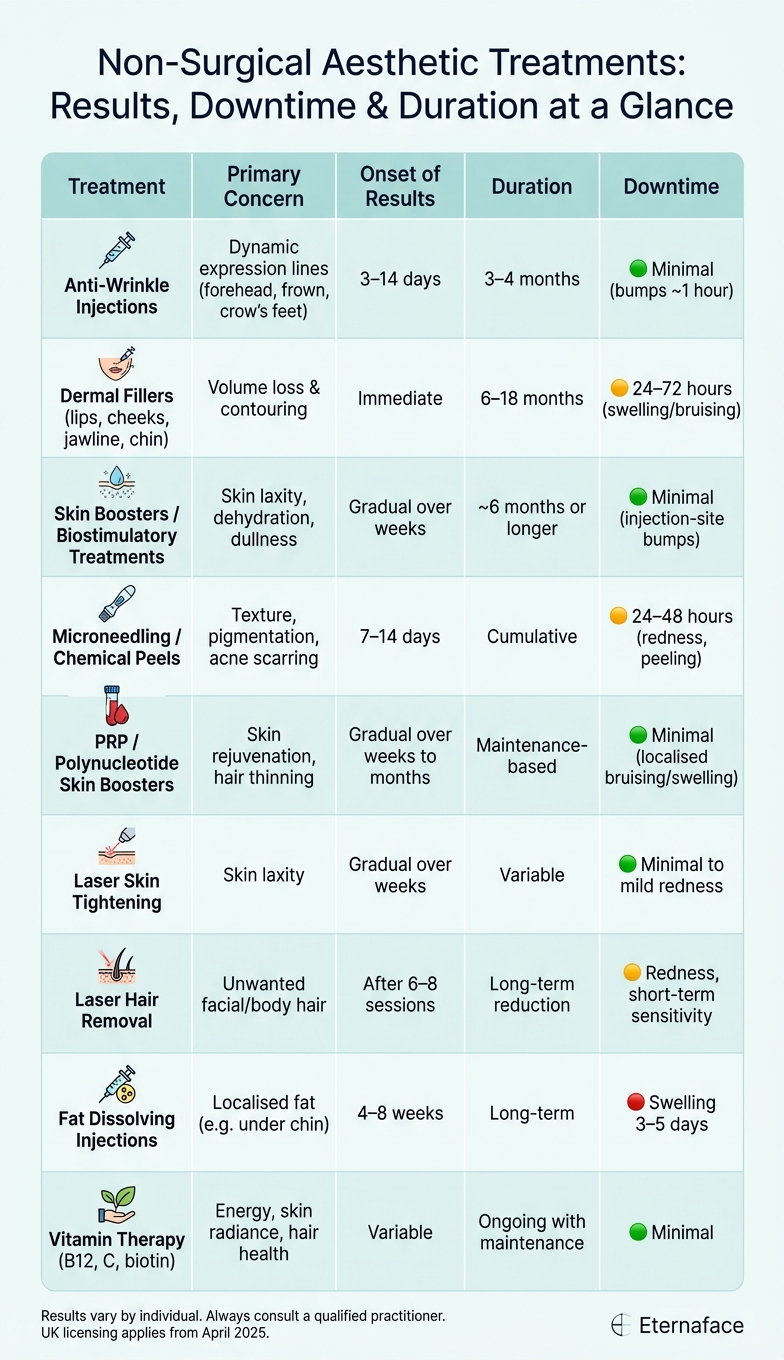
Non-Surgical Aesthetic Treatments: Results, Downtime & Duration at a Glance
The assessment should guide the plan. Each concern needs the least invasive treatment that can still do the job, based on anatomy, skin quality and downtime. This is a clinical call, not a pick-and-mix service. From there, the next step is to match each concern to the treatment type that fits best.
Matching Concerns to Treatments: Wrinkles, Volume, Skin Quality and Contour
Dynamic expression lines – forehead creases, frown lines and crow’s feet – are usually treated with anti-wrinkle injections (botulinum toxin). Results tend to show within 3–14 days and last for around 3–4 months. Static lines, which stay visible even when the face is at rest, may need dermal fillers, skin resurfacing or biostimulators if you want a clear improvement.
Volume loss in the cheeks, temples, chin or jawline is often treated with hyaluronic acid dermal fillers. These give an immediate result and usually last 6–18 months, depending on the area. If the aim is slower change in skin quality and laxity, skin boosters and biostimulatory treatments are often planned as a course of sessions rather than a single visit.
Skin quality concerns – dullness, uneven texture, pigmentation and acne scarring – sit in their own lane. Treatments such as microneedling, chemical peels, PRP and polynucleotide skin boosters work on the skin’s structure over time, usually across a series of sessions. Laser skin tightening can also help clients with early laxity.
The table below sums up when results tend to appear, how long they last and what kind of downtime to expect from common treatment options.
Treatment Comparison Table: Results, Downtime and Suitability
| Treatment | Primary Concern | Onset of Results | Duration | Downtime | Key Suitability Notes |
|---|---|---|---|---|---|
| Anti-Wrinkle Injections | Dynamic expression lines | 3–14 days | 3–4 months | Minimal (small bumps for about 1 hour) | Disclose blood thinners and supplements |
| Dermal Fillers (lips, cheeks, jawline, chin) | Volume loss, contouring | Immediate | 6–18 months | 24–72 hours (swelling/bruising) | Requires anatomical mapping |
| Skin Boosters / Biostimulatory Treatments | Skin laxity, dehydration, dullness | Gradual over weeks | About 6 months or longer | Minimal (small injection-site bumps) | Often used for early laxity |
| Microneedling / Chemical Peels | Texture, pigmentation, acne scarring | 7–14 days | Cumulative | 24–48 hours (redness, peeling) | Fitzpatrick skin type guides peel depth |
| PRP / Polynucleotide Skin Boosters | Skin rejuvenation, hair thinning | Gradual over weeks to months | Maintenance-based | Minimal (localised bruising/swelling) | PRP requires a blood draw |
| Laser Skin Tightening | Skin laxity | Gradual over weeks | Variable | Minimal to mild redness | Best for mild-to-moderate laxity |
| Laser Hair Removal | Unwanted facial/body hair | After 6–8 sessions | Long-term reduction | Redness, short-term sensitivity | Fitzpatrick scale assesses pigment risk |
| Fat Dissolving Injections | Localised fat (e.g. under the chin) | 4–8 weeks | Long-term | Swelling for 3–5 days | Suitable for targeted areas only |
| Vitamin Therapy (B12, C, biotin) | Energy, skin radiance, hair health | Variable | Ongoing with maintenance | Minimal | Used as an adjunct, not a primary aesthetic treatment |
Once the plan is set out, the consultation moves to risks, consent and aftercare.
Risks, Consent and Aftercare
Side Effects, Complications and Informed Consent
Every treatment plan should be checked for risk before anything goes ahead. Across injectables, peels and laser treatments, common side effects include bruising, swelling, redness and temporary asymmetry. That said, consent also needs to cover the less common but more serious problems.
With dermal fillers, the risk that matters most is vascular occlusion. This happens when filler blocks blood flow to tissue. It is rare, but it needs urgent treatment and cannot wait until the next working day. Infection, product migration and lumps that do not settle can also happen. With peels and laser treatments, post-inflammatory hyperpigmentation is another key risk. In plain English, that means darkening after inflammation, and it can be more likely in clients with darker skin tones, especially Fitzpatrick Types IV–VI.
Under the Montgomery ruling, UK clinicians must explain all material risks. That means any risk that a reasonable person in your position would want to know before saying yes to treatment. Consent should cover risks, limits, costs, recovery, and the choice not to treat. Good clinics also use a cooling-off period before treatment takes place. If a clinic presses you to have treatment on the same day, or waves a discount that ends when your appointment does, treat that as a red flag.
Once those risks have been explained and consent has been signed, aftercare becomes the next part of staying safe.
Aftercare by Treatment Type: First 24 Hours, 48–72 Hours and Longer-Term Skin Care
Aftercare is part of treatment safety. It should fit the treatment you have had. The details vary, but one thing should always be clear: you need to know what is normal, what is not, and when to get help.
| Treatment Category | First 24 Hours | 48–72 Hours | Longer-Term Care | Contact the Clinic If… |
|---|---|---|---|---|
| Injectables (Toxin/Filler) | Avoid heavy exercise, alcohol, extreme heat and makeup on the treated area | Avoid firm pressure or massage on the area | Stay hydrated; attend the planned review | Severe pain, skin blanching, patchy colour change, or increasing heat, redness or pain |
| Chemical Peels / Microneedling | Avoid touching the skin; use only a gentle, recommended cleanser | Avoid active ingredients – retinol, vitamin C, AHAs and BHAs; do not pick at peeling skin | Use SPF 30+ daily; repair the skin barrier with consistent moisturising | Signs of infection (pus, spreading redness) or unexpected scarring |
| Laser Treatments | Avoid heat and direct sun | Continue avoiding skin irritants; keep the skin well hydrated | Use SPF 30+ daily to help reduce the risk of darkening after inflammation | Blistering, crusting or significant pigment changes |
Before you leave, the clinic should give you a clear plan for what to do if something goes wrong. Ask for the clinic’s out-of-hours contact number before you go. Problems do not always wait for office hours, and you should know exactly who to call if something looks off.
Follow-Up, Maintenance and Key Takeaways
Review Appointments and Long-Term Maintenance Planning
After treatment, review appointments connect your aftercare with the next step in the plan. For anti-wrinkle injections, the usual review point is about 2 weeks after treatment. For dermal fillers, reviews tend to happen at 2–4 weeks, once swelling has gone down and the filler has settled. PRP and skin boosters are usually reviewed after a full course of 3–6 sessions.
Once swelling has settled, baseline photos become most useful. Looking at your post-treatment result beside photos taken before anything was done gives both you and your practitioner a clear reference point. It’s also the right time to correct subtle asymmetry.
Tracking facial change over time helps for a simple reason: memory can be patchy. A steady photo record makes it easier to adjust the treatment plan as your skin and facial structure change.
Long-term maintenance tends to work better when it’s planned in phases, not treated like a string of quick fixes. Review results help shape what comes next. That might mean working on skin quality with peels or microneedling before moving to structural concerns with injectables. The plan stays tied to what the assessment shows, rather than to a rigid timetable.
What to Look for in a Safe, Personalised Consultation
If you want a safe consultation, a few things should be in place from the start:
- Practitioner registration – check that your practitioner appears on a recognised register such as Save Face or the JCCP, and has the right qualifications.
- Written treatment plan – you should leave with a document that lists the treatment name, expected quantity, total cost, and your scheduled review date.
- No same-day pressure – a cooling-off period between consultation and treatment is standard practice. Pressure to go ahead straight away, or to take a time-limited discount, is a red flag.
FAQs
How do I prepare for my consultation?
Turn up with a clean face and no make-up. That gives the clinician a clear view of your skin and facial features.
Bring:
- a list of your current medicines and supplements
- details of any medical conditions
- information about past cosmetic treatments, including the dates and the areas treated
It may also help to bring older facial photos and a note of any questions you want to ask.
This appointment is a clinical assessment, not a sales meeting. Take your time, think through the advice, and don’t feel pushed into booking treatment on the spot.
How do I know which treatment is right for me?
Choose a consultation-led clinic that takes the time to look at your medical history, current medicines, and how your face looks both at rest and in motion. They should also check your skin barrier and overall skin quality.
You should leave with a written plan that sets out:
- the treatment areas
- the approximate amount
- the results you can expect
- the timing
- the review date
- the pricing
- the risks
- the alternatives, including doing nothing
If the appointment feels rushed, take that as a warning sign. The same goes if the risks, limits, or likely outcome aren’t explained in plain English.
What red flags should I watch for in a clinic?
Be careful with clinics that push you to book or pay there and then. A good provider should take a full medical history and make sure any prescription-only treatment is assessed face to face by a qualified prescriber.
Steer clear of high-pressure sales tactics too. The same goes for clinics that make promises based on celebrity photos, or fail to clearly explain the risks, possible complications, aftercare, qualifications, registration, and emergency contact procedures.