
Botox changes by age, but age is not the main factor. What matters most is whether your lines only show when you move, or whether they stay there when your face is resting—a distinction often clarified during personalized skin consultations.
Here’s the short version:
- In your 20s, Botox is often about small-dose prevention.
- In your 30s, it usually shifts to maintenance.
- In your 40s, it often becomes part of a broader plan because lines may stay visible at rest.
- In your 50s, the focus is often gentle softening of deeper lines while keeping movement natural.
A few numbers help show the pattern:
- 20s: often 10 to 20 units
- 30s: often 20 to 40 units
- 40s: often 30 to 50 units
- 50s: often 40 to 60+ units
- Timing is often every 4 to 6 months in the 20s and every 3 to 4 months from the 30s onwards
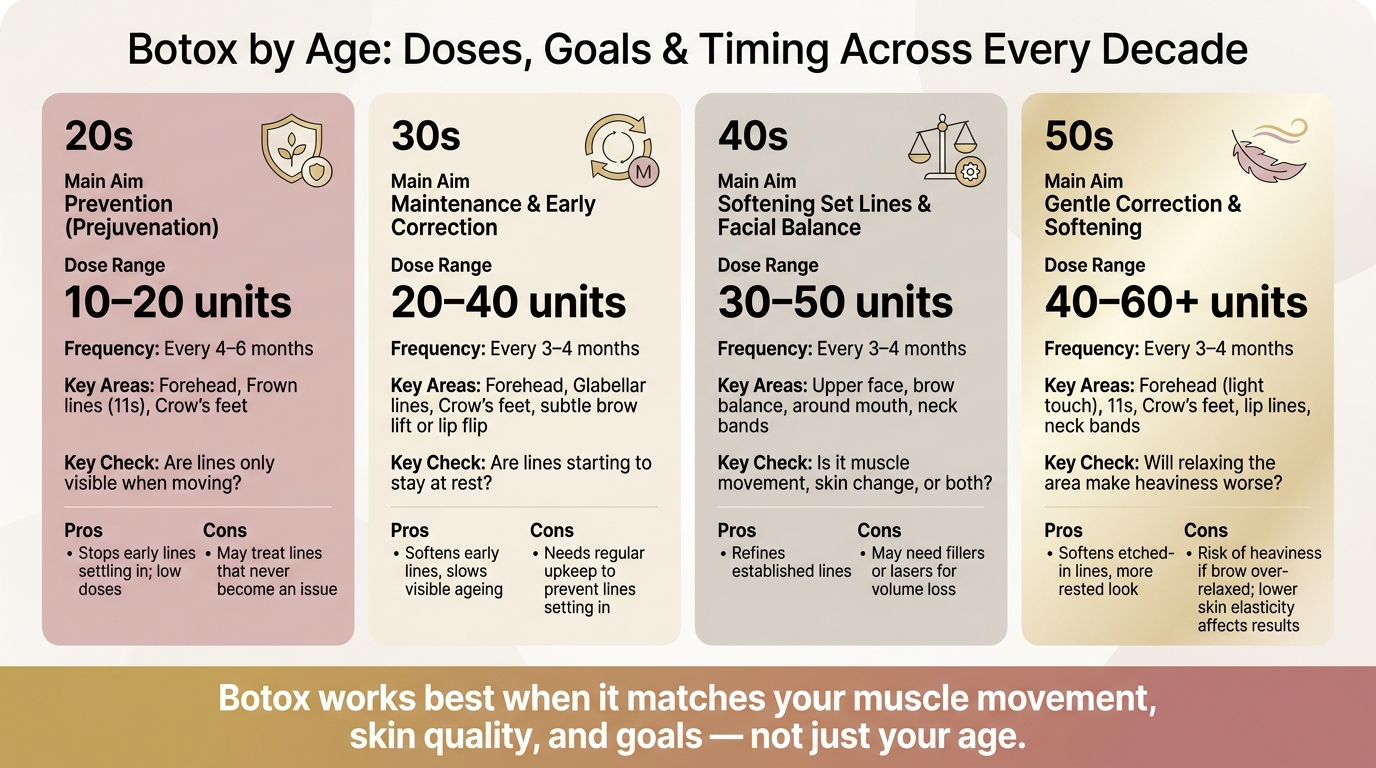
Botox by Age: Doses, Goals & Timing Across Every Decade
Botox by Age: 20s vs 30s vs 40s
sbb-itb-4219cc3
Quick Comparison
| Age | Main aim | Common dose range | Main point to check |
|---|---|---|---|
| 20s | Prevention | 10 to 20 units | Are lines only visible when moving? |
| 30s | Maintenance | 20 to 40 units | Are lines starting to stay at rest? |
| 40s | Softening set lines | 30 to 50 units | Is it muscle movement, skin change, or both? |
| 50s | Gentle correction | 40 to 60+ units | Will relaxing the area make heaviness worse? |
If I had to sum it up in one line, it would be this: Botox works best when it matches your muscle movement, skin quality, and goals, not just your age. That’s the main takeaway from the full article below.
1. Botox in Your 20s
In your 20s, Botox is usually light and precise. The goal isn’t to overhaul your face. It’s to slow the start of expression lines before they begin to stick around. You’ll often hear this called prejuvenation: small amounts used to soften repeated muscle movement before lines settle in.
Treatment Goals
At this stage, the main focus is dynamic lines. These are the lines that show up when you move your face, like when you lift your brows, frown, or smile, then fade when your face is at rest.
That detail matters. If a line is still visible when your face is relaxed, Botox on its own is less likely to smooth it fully.
Dose Patterns and Common Areas
Treatment in your 20s usually involves lower doses than later, more corrective work. Think of it as a softer touch. Micro-doses can reduce movement without making the face look stiff or flat, and consultations often mention 10 to 20 units in total.
The most common areas are:
- Forehead
- Frown lines, or the "11s"
- Crow’s feet
Some clinics may also talk through secondary areas, such as bunny lines, chin dimpling, and early neck bands.
Consultation Focus
A good consultation in your 20s should look closely at whether your lines are still purely dynamic or starting to stay visible at rest. Providers may also ask about muscle strength and whether early wrinkling runs in your family.
A lot of people at this age ask the same things: Am I starting too early? Will I look frozen? Will I need to keep doing this once I begin?
If lines disappear fully when your face is relaxed, treatment is often too early.
The aim is still subtle. But upkeep starts to matter more here. Appointments are often spaced every 4 to 6 months, rather than the 3 to 4 months more often seen in later decades. And one point is easy to miss: Botox doesn’t replace skincare. Sunscreen still does a lot of the heavy lifting.
2. Botox in Your 30s
Your 20s are often about prevention. Your 30s are more about upkeep.
At this stage, Botox tends to shift from prevention into maintenance and early correction. The goal is to stop lines from settling into the skin when your face is at rest.
That shift happens for a simple reason: collagen production slows down, and skin cell turnover does too. So lines can hang around longer, even when you’re not making an expression. You may also notice makeup slipping into fine creases more than it used to.
Treatment Goals
The aim is to look rested, not frozen.
Dose Patterns and Common Areas
Typical treatment totals often move up to 20 to 40 units, based on muscle strength and how many areas are being treated.
The main treatment zones are still the forehead, glabellar lines, and crow’s feet. In some cases, a subtle brow lift or a lip flip is added.
Consultation Focus
Consultations usually centre on one key point: do the lines still disappear when your face is at rest, or do they now need more support than Botox alone can give?
Appointments are often spaced every 3 to 4 months. If you let the treatment wear off fully, movement tends to come back. And by the time you reach your 40s, those lines are more likely to stick around at rest.
3. Botox in Your 40s
If your 30s are mostly about maintenance, your 40s are more about balance. At this stage, Botox usually shifts from prevention to correction. Lines are more likely to stick around even when your face is resting, so treatment needs to deal with both muscle movement and changes in facial support.
Collagen, elastin and underlying fat tend to decline more noticeably in this decade. That means lines that once showed up only when you frowned or raised your brows can start to stay visible at rest. In your 40s, Botox often works best as part of a broader facial plan rather than a standalone answer.
Treatment Goals
The goal is to soften set-in lines, restore facial balance and keep the result looking natural. For example, treating only the forehead while ignoring volume loss in the midface can leave the overall look feeling out of sync.
Dose Patterns and Common Areas
Typical treatment totals in your 40s often range from 30 to 50 units, compared with 20 to 40 units in your 30s. Treatment still usually begins in the upper face, but it often extends to brow balance, refinement around the mouth and neck bands.
People who started regular treatment in earlier decades may have less movement to correct, so some need fewer units than you might expect.
Consultation Focus
At this stage, the main question is simple: is the line coming from muscle movement, or from skin change and volume loss? Botox treats movement. Fillers, microneedling or lasers may be added when skin quality or volume loss is the bigger issue . Maintenance usually stays on a 3 to 4 month cycle .
4. Botox in Your 50s
By your 50s, the goal usually changes. Instead of prevention, Botox is more about gentle correction. Skin tends to get thinner, elasticity drops, and lines can stick around more easily. Botox can help with movement-related lines, but it doesn’t treat volume loss or skin laxity.
Treatment Goals
The aim is simple: soften lines that stay visible at rest while still keeping your facial movement natural.
Dose Patterns and Common Areas
In your 50s, typical treatment totals often fall between 40 to 60+ units. The usual areas still include the forehead, glabellar “11” lines, and crow’s feet. In some cases, treatment may also include lip lines, neck bands, and a subtle brow lift.
There’s one area that needs extra care: the forehead. If the upper lids already feel heavy, the forehead muscles may be working overtime to help lift the brows. Treat that area too strongly, and the heaviness can look worse. That’s why a lighter hand is often the smarter option.
Consultation Focus
A good consultation in your 50s should be clear about what Botox can and can’t do. It may soften deep lines, but it won’t fix laxity or replace lost volume. Those issues often call for other treatments.
That’s why Botox at this stage is often part of a broader plan. At Eternaface, personalised consultations can help map out whether Botox makes sense on its own or whether it should sit alongside fillers or laser skin tightening. That leads into the next question: whether starting Botox earlier or later changes the result.
Starting Botox Earlier vs Later: Pros and Cons by Decade
Once you look at the differences from one decade to the next, the key issue becomes pretty clear: is Botox being used to prevent lines, keep results steady, or soften lines that are already set in?
There isn’t one perfect age to start Botox. What matters more is when dynamic lines start hanging around even when your face is at rest.
That’s the better marker. Not turning 30, 40, or 50.
The goal at any age is to keep natural expression, not to iron out every bit of movement. Botox tends to make the most sense when expression lines stop disappearing fully between movements.
Here’s how the trade-offs tend to look by decade:
| Decade | Pros | Cons | Best-Suited Patient Goals |
|---|---|---|---|
| 20s | Helps stop early lines from settling in; low doses often do the job | You may end up treating lines that never would have turned into an issue; it often leads to long-term upkeep | Subtle prevention and early care for very expressive faces |
| 30s | Helps soften early lines | Needs regular maintenance to stop lines becoming more set | Keeping skin smoother and slowing early visible ageing |
| 40s | Helps refine lines that are already more established | Botox on its own may not do enough for deeper static creases or volume loss | Treating visible lines and refining facial appearance |
| 50s | Can soften etched-in lines and give the upper face a more rested look | There’s more chance of heaviness if the brow is relaxed too much; lower skin elasticity can shape the result | Gentle rejuvenation and softening lines that have already set in |
Conclusion
Botox itself doesn’t change. The way it’s used does. In your 20s, it’s often about prevention. By your 50s, it’s more about softening lines that have had time to settle in. So age is a starting point, not the thing that decides everything.
What matters more is muscle activity, skin quality, facial balance, and how much movement you want to keep.
The next step is a consultation shaped around your face, not a one-size-fits-all age bracket. If you’re in Bristol, Bath, Cardiff, Swindon, Newport or Gloucester, a personalised consultation at Eternaface can match treatment to your anatomy, skin and goals.
FAQs
How do I know if I’m too young for Botox?
There’s no fixed age to start Botox. It comes down to your skin, facial anatomy, and what you want to change, not a certain birthday.
So, if you’re over 18, you’re not automatically too young. But that doesn’t mean you should rush into treatment either. If you don’t have any visible concerns, it’s often best to leave it alone.
A consultation at Eternaface may be worth considering if you’ve started to notice dynamic lines that bother you, or if those lines are beginning to stick around even when your face is at rest. If you’re on the fence, a professional assessment can help you work out whether now makes sense or whether it’s better to wait.
Can Botox still help if my lines show at rest?
Yes. Botox can still help if lines are visible at rest.
It works by relaxing the muscles behind repeated facial movements. That can soften static lines and help stop them from getting deeper over time.
That said, it may not fully remove lines that are already deeply etched into the skin. If those lines are more marked, your practitioner may suggest Botox alongside treatments such as dermal fillers, chemical peels or laser resurfacing.
How often would I need Botox top-ups?
For most patients, Botox lasts three to four months, which is why quarterly appointments are common if you want to keep results looking steady. The right timing for you comes down to muscle activity, skin elasticity, and your aesthetic goals.
In your 20s, some patients can leave four to six months between appointments. In your 30s and 40s, every three months is often the usual plan. In your 50s, results may last a little longer, but three to four months is still common.