
If I want to smooth lines from facial movement, Botox is usually the better fit. If I want to treat hollows, folds or loss of volume at rest, fillers are usually the better choice.
That is the short answer. Botox works by relaxing muscles, so it is often used for forehead lines, frown lines and crow’s feet. Dermal fillers work by adding volume under the skin, so they are often used for lips, cheeks, jawline, chin and nasolabial folds.
Here is the simple breakdown:
- Botox = best for dynamic lines that show when I smile, squint or frown
- Fillers = best for static lines and hollows that stay visible when my face is still
- Botox results usually show in 3 to 7 days, with full effect at about 2 weeks
- Fillers results are immediate
- Botox often lasts 3 to 6 months
- Fillers often last 6 to 12+ months
- HA fillers can be dissolved if needed
- Many people use both when they have movement lines and volume loss
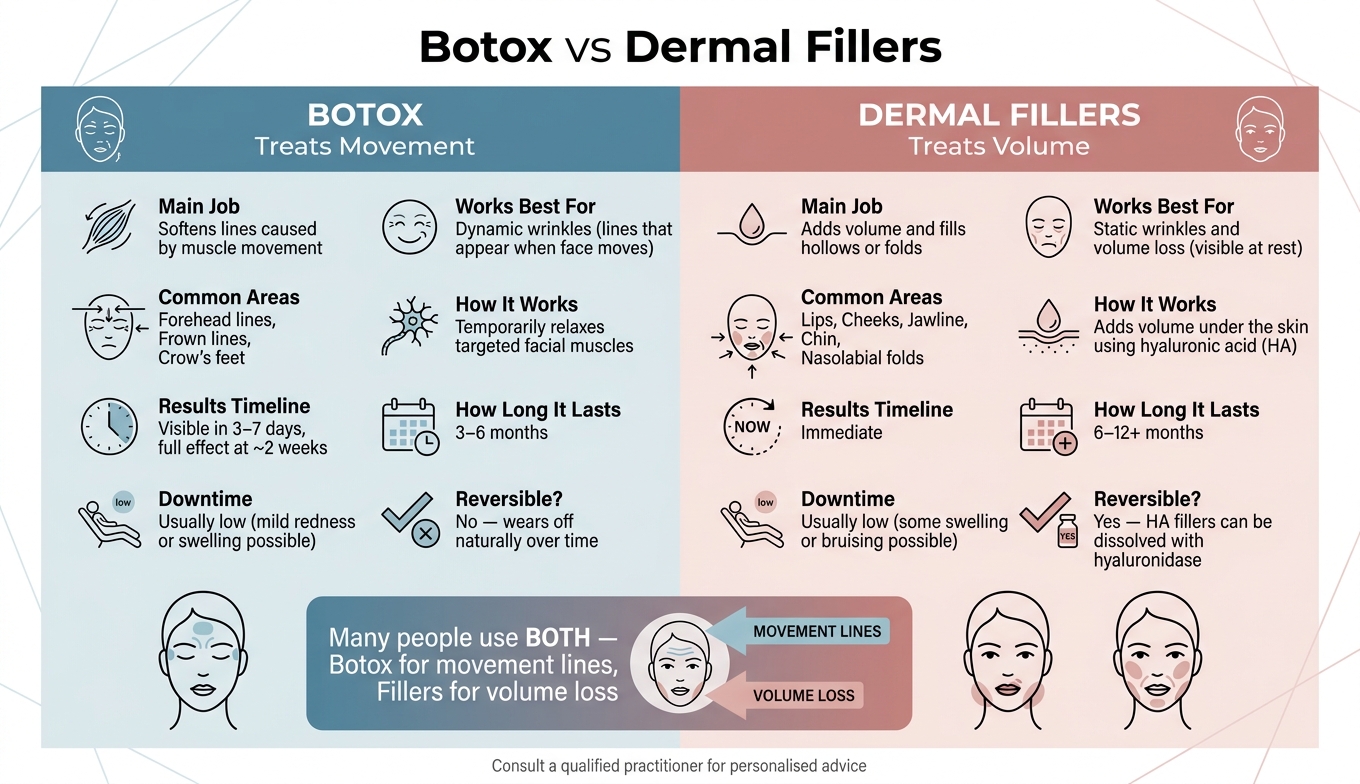
Botox vs Dermal Fillers: Side-by-Side Comparison
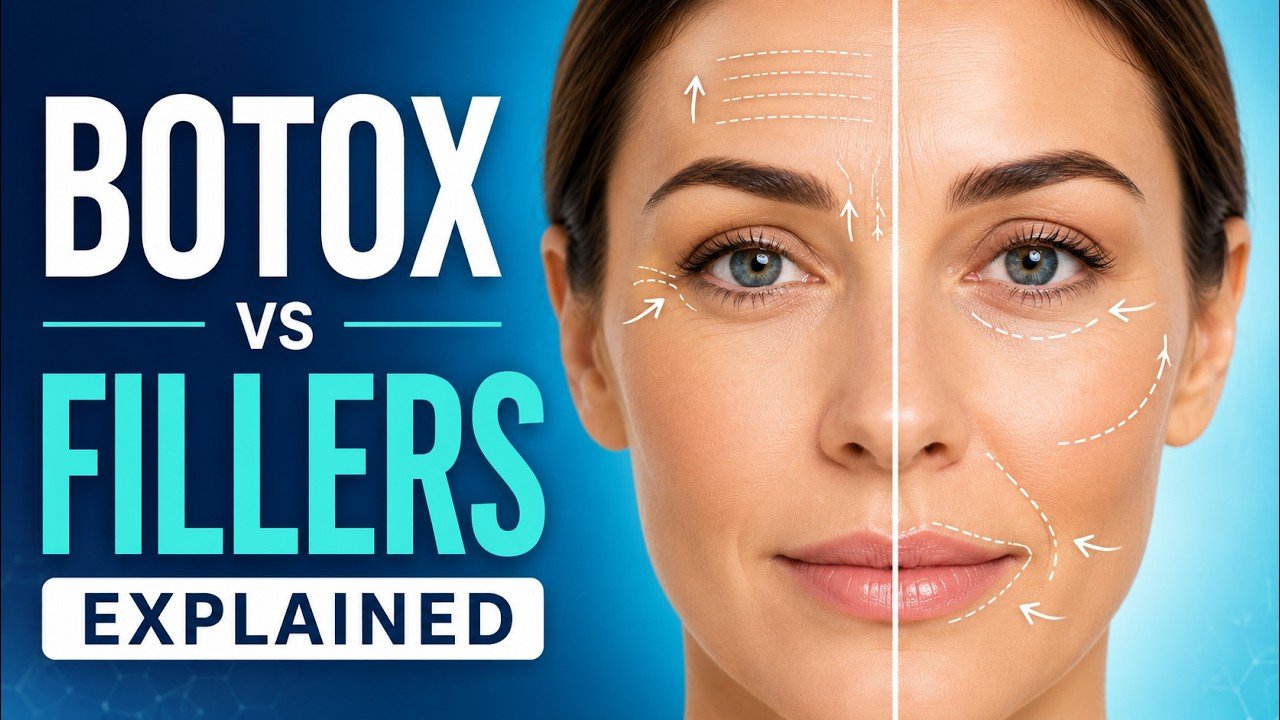
Botox vs. Fillers: What’s the Difference?
sbb-itb-4219cc3
Quick Comparison
| What I’m comparing | Botox | Dermal fillers |
|---|---|---|
| Main job | Softens lines caused by muscle movement | Adds volume and fills hollows or folds |
| Works best for | Dynamic wrinkles | Static wrinkles and volume loss |
| Common areas | Forehead, frown lines, crow’s feet | Lips, cheeks, jawline, nasolabial folds |
| How fast it works | 3–7 days, full effect around 2 weeks | Immediate |
| How long it lasts | 3–6 months | 6–12+ months |
| Downtime | Usually low | Usually low, with some swelling or bruising at times |
| Can it be reversed? | No, it wears off over time | Yes, HA fillers can be dissolved |
Put another way: Botox treats movement. Fillers treat volume. If I can still see the issue when my face is fully relaxed, fillers are often the better match. If the line shows up mostly when I move, Botox is often the place to start.
This guide gives a plain-English view so I can go into a consultation with a clear idea of what each treatment is for.
How Botox works and when it is the right choice
Botox (botulinum toxin type A) temporarily relaxes targeted facial muscles by reducing muscle contraction, which softens dynamic lines. Put simply, Botox tends to be the better fit for lines that show up when your face moves.
Best suited to forehead lines, frown lines and crow’s feet
Botox is mainly used on the upper face: forehead lines, frown lines between the eyebrows, and crow’s feet around the eyes. It relaxes the muscles behind each crease, so the skin above looks smoother without adding volume.
That point matters. If the issue is volume loss in the lips, cheeks, jawline, or nasolabial folds, fillers are usually a better option. So if you’re dealing with lost fullness rather than expression lines, dermal fillers are often the better match.
Results, longevity and downtime
Results usually last three to six months, depending on the area treated and individual factors. Treatment itself usually takes around 30 minutes, and downtime is minimal. Most people only notice mild redness, swelling, or bruising at the injection sites.
How dermal fillers work and when they are the right choice
Dermal fillers work in the opposite way to Botox. While Botox injections relax muscles to smooth dynamic lines, fillers address volume loss. Instead of relaxing muscles, they add volume and support under the skin. Most modern fillers are made with hyaluronic acid (HA), a substance that occurs naturally in the body. HA fillers draw in water and help bring back lost fullness beneath the skin.
Best suited to lips, cheeks, jawline and nasolabial folds
Because of that, fillers are usually better for areas that have lost fullness, not lines caused by facial movement. They’re often used for lines, folds and hollows that are still visible when your face is at rest.
Common treatment areas include:
- Lips, where fillers can add volume or soften the lip border
- Cheeks, where they bring back cheek volume and give a slight lift
- Jawline and chin, where firmer fillers can sharpen structure and bring back facial definition
- Nasolabial folds, the deeper creases that run from the nose to the corners of the mouth
Results, longevity and reversibility
One of the main draws is that results are immediate and usually last around 9–12 months. Another big plus is that HA-based fillers can be reversed. If you’re unhappy with the result, or if there’s a complication, the filler can be dissolved with an enzyme called hyaluronidase.
Next, compare fillers with Botox on results, recovery and best use cases.
Botox vs fillers: comparing results, recovery and best use cases
Use this section to match the treatment to your concern.
Matching each treatment to your concern
Now that the basics are clear, the choice comes down to what you want to change. The simplest way to decide is by the cause: movement lines usually point to Botox, while volume loss usually points to fillers.
If lines show up when you lift your brows, squint or frown, Botox is often the best place to start. If an area looks flat, hollow or deflated even when your face is at rest, fillers tend to be a better fit.
Here’s a simple way to think about it:
- Botox suits lines caused by muscle movement, such as frown lines between the brows or forehead lines that deepen with expression.
- Fillers suit areas that have lost shape or fullness, such as hollow cheeks, thinner lips or deep nasolabial folds that stay visible at rest.
When using both treatments together makes sense
Many people are dealing with both dynamic lines and volume loss at the same time. That’s where things get more practical: one treatment can’t do both jobs well. Botox helps soften movement lines, while fillers add back lost volume.
This is why a combined plan can make sense. It treats lines and restores volume within one plan, with each treatment used where it does its job best.
That’s often called a combined treatment plan. Put simply, it means not asking one treatment to fix a problem it wasn’t made for.
The conclusion below turns these differences into a simple choice.
Conclusion: how to decide what is right for you
The choice usually comes down to one main issue: movement lines or lost volume.
Botox tends to work best for lines that show up when your face moves – when you smile, frown or squint. Dermal fillers tend to work best when an area looks flat or hollow even when your face is fully at rest.
Put simply, hollows and deeper fixed lines at rest usually point to fillers. Lines that appear mainly with movement usually point to Botox. If it still feels a bit hard to tell, the next step is a personalised facial assessment.
Ageing doesn’t look the same on every face, so treatment should be matched to the person. For readers in Bristol, Bath, Cardiff, Swindon, Newport and Gloucester, a personalised facial assessment can help match the right treatment to your features.
FAQs
How do I tell if my lines are dynamic or static?
Dynamic lines show up or get deeper when you move your facial muscles, like when you smile, frown, or squint.
Static lines are still there even when your face is resting. If you’re not sure which you have, a professional consultation can give you a clear assessment based on your facial goals.
Can Botox and fillers be used together?
Yes. Botox and dermal fillers can be used together to treat different signs of ageing.
Botox relaxes the facial muscles that cause dynamic lines, such as forehead lines and crow’s feet. Dermal fillers add volume in areas like the cheeks, lips and nasolabial folds.
Used together, they can give a more complete, natural-looking result when planned by a skilled clinician.
What happens if I do not like filler results?
If you’re unhappy with the result, many hyaluronic acid dermal fillers are fully reabsorbable. That means the effect will usually soften and fade over time, rather than staying in place permanently.
If you want a faster fix, book a follow-up consultation so your clinician can assess the result and talk you through the next steps. If crosslinked HA was used, the filler can last longer, often for months.