
If you want help with pigment, dull skin, or breakouts, I’d usually look at peels first. If you want help with pitted acne scars, lines, or skin texture, I’d usually look at microneedling first.
That’s the short answer. One treatment works more on the surface. The other works more under the skin. Your best option often comes down to:
- what you want to treat
- how much downtime you can deal with
- how your skin reacts
- how many sessions you’re willing to have
A few points stand out straight away:
- Chemical peels can give a more visible change for pigmentation, congestion, and dullness
- Microneedling is often the better pick for sunken acne scars and skin remodelling
- Medium-depth TCA peels can be painful, with one study reporting 7.58/10 pain
- Biorevitalising peels may have no visible peeling and no required downtime
- Both are often done as a course of 5 to 10 sessions
- Fitzpatrick IV+ skin needs more care with medium-depth TCA peels because of a higher risk of post-inflammatory hyperpigmentation
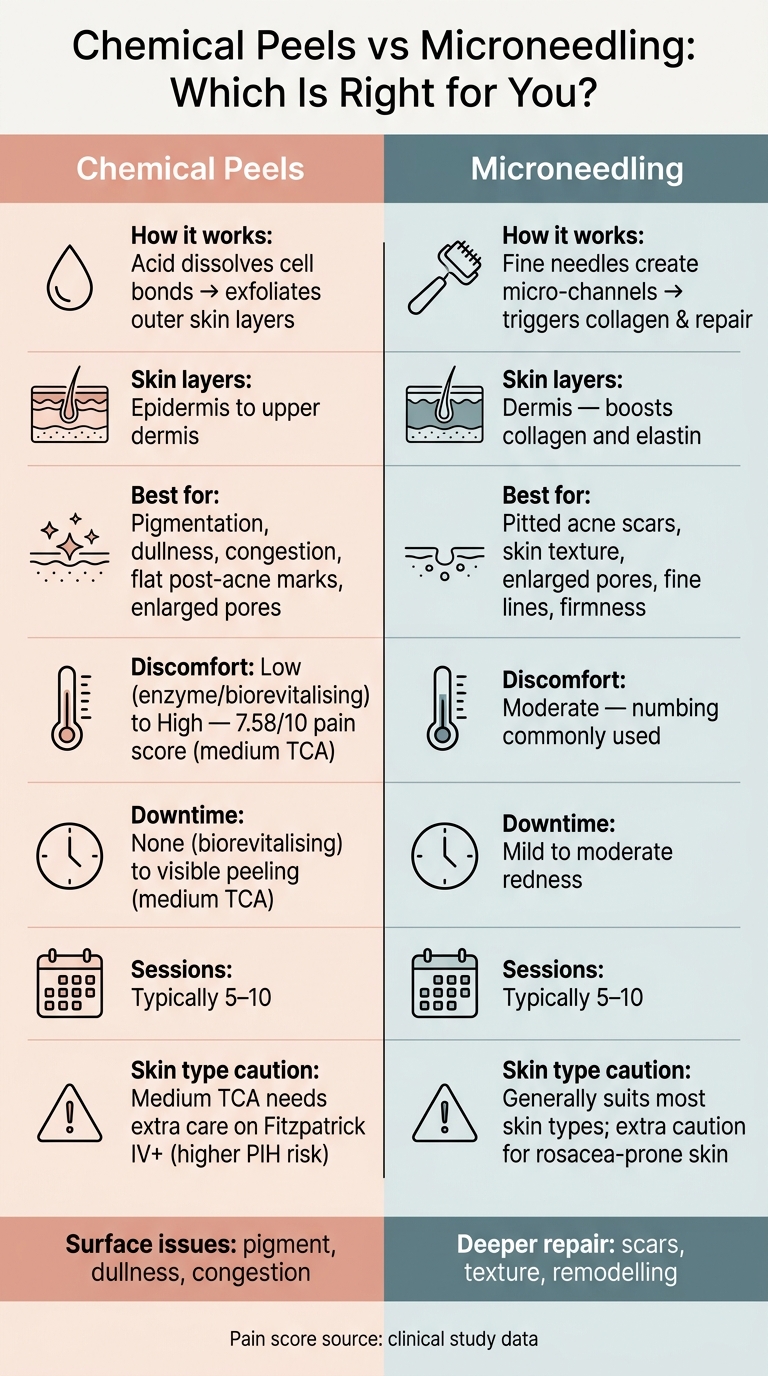
Chemical Peels vs Microneedling: Side-by-Side Comparison
Quick Comparison
| Treatment | Best for | How it works | Downtime | Skin-type note |
|---|---|---|---|---|
| Chemical peel | Pigment, dullness, pores, congestion, flat post-acne marks | Removes dead skin and resurfaces the top layers | Varies from none to visible peeling | Medium TCA needs more care in Fitzpatrick IV+ |
| Microneedling | Pitted acne scars, texture, pores, lines, firmness | Tiny needles trigger repair and collagen | Mild to moderate redness | Often suits most skin types |
If I strip it down even more, it’s this: peels tend to suit surface problems; microneedling tends to suit deeper repair. The rest is about matching the treatment to your skin goal, skin type, and recovery time.
sbb-itb-4219cc3
How Chemical Peels and Microneedling Work
Chemical Peels: Exfoliation and Resurfacing
A chemical peel uses acids to lift away dead skin cells and resurface the skin. That exfoliation is controlled, and the depth depends on the type of peel. The deeper the peel goes, the more change you can expect to see – but also the more recovery time you’ll usually need.
Superficial peels – often made with glycolic or salicylic acid – work on the outermost part of the epidermis. They’re a good fit for dull skin, blackheads, and mild congestion. Medium-depth peels, such as those using 30% trichloroacetic acid (TCA), reach the upper dermis and can help with collagen renewal and skin firmness. Deeper peels go further into the skin, which affects both results and downtime.
Microneedling: Collagen Induction and Skin Remodelling
Microneedling uses fine needles to make tiny channels in the skin. This kicks off the skin’s repair response and encourages collagen production. Over time, the skin rebuilds itself from within, which is why microneedling is often used for sunken acne scars, enlarged pores, and uneven texture. That sets up the next part of the comparison: which treatment fits which skin concern.
| Chemical Peels | Microneedling | |
|---|---|---|
| How it works | Acid dissolves cell bonds, triggering exfoliation | Fine needles create tiny channels, triggers repair |
| Skin layers affected | Epidermis to upper dermis (depth varies by peel) | Dermis – boosts collagen and elastin |
| Best suited for | Pigmentation, dullness, surface texture, congestion | Atrophic scars, wrinkles, pores, skin firmness |
| Immediate effect | Peeling and shedding of outer skin | Gradual remodelling; redness and minor swelling initially |
These differences matter most when you’re matching a treatment to scars, pigmentation, texture, or tone. That’s where the gap between the two becomes much clearer.
Key Differences by Skin Concern
If your main issue sits on the surface of the skin, peels often make more sense. If the problem is deeper in the skin’s structure, microneedling is often the better fit. So the choice usually comes down to this: do you want surface exfoliation, pigment correction, or deeper remodelling?
Acne Scars, Post-Acne Marks, and Breakouts
Microneedling is usually the stronger option for pitted acne scars because it supports dermal repair. Medium-depth TCA peels can help here too, as they promote collagen remodelling.
For active breakouts and congestion, chemical peels are often the more direct route. Salicylic acid and TCA peels are commonly used for active acne and enlarged pores, while kojic acid-based peels are better suited to flat post-acne marks and uneven tone.
Pigmentation, Melasma, and Uneven Skin Tone
When the goal is to treat pigmentation and uneven tone, chemical peels usually give the most direct visible change. Peels made with depigmenting agents and kojic acid are designed to reduce hyperpigmentation and uneven pigmentation. Some revitalising formulas have shown improvement from the first session.
There is one catch. Medium-depth TCA peels need extra caution on Fitzpatrick 4+ skin types, because these skin types were often left out of studies. Microneedling is generally suitable for most skin types.
Fine Lines, Dullness, Pores, and Texture
For dullness, enlarged pores, and early fine lines, peels tend to give the faster visible boost. Revitalising peels can create an immediate tightening and radiance effect through deeper collagen stimulation.
Microneedling makes more sense if you’re looking for skin remodelling rather than a fast glow. That’s why it’s often a strong choice for texture and elasticity concerns. Medium-depth TCA peels can also help with fine lines and texture by promoting collagen remodelling and increasing elastic fibres.
Downtime and skin type are the next things to weigh up.
| Skin Concern | Better-Suited Treatment | Expected Timeline |
|---|---|---|
| Active breakouts and congestion | Salicylic acid or TCA peel | Often improves quickly |
| Flat post-acne marks | Kojic acid-based peel | Often visible after one session |
| Pitted acne scars | Microneedling or medium-depth TCA peel | Gradual remodelling |
| Hyperpigmentation and uneven tone | Chemical peel | Often visible after one session |
| Dullness, pores, early fine lines | Revitalising peel or microneedling | Peels: faster glow; microneedling: slower remodelling |
Downtime, Discomfort, Sessions, and Skin Type Safety
What the Appointment and Recovery Usually Feel Like
Once you know which treatment you’re looking at, comfort and recovery often become the deal-breakers.
A medium-depth TCA peel can feel intense. In one study, pain was recorded at 7.58/10 straight after treatment. That’s not a small thing if you’ve got work, social plans, or you just don’t want your face to feel on fire for the day.
Biorevitalising peels sit at the other end of the scale. They work in deeper skin layers without damaging the surface, so there’s no visible peeling and no required downtime. Most people go back to normal activities the same day.
Microneedling usually lands somewhere in the middle. It often causes moderate discomfort, and numbing is commonly used to make the treatment easier to tolerate.
How Many Sessions Are Usually Needed
This isn’t usually a one-and-done situation. Both options are often done as a course, with most plans using 5 to 10 sessions.
Biorevitalising peels can improve firmness and radiance from the first session. Microneedling can also show early visible changes, especially for texture and signs of ageing.
Which Skin Types Need Extra Caution
Skin type matters a lot here.
For Fitzpatrick IV and above, medium-depth TCA peels need extra care because the risk of post-inflammatory hyperpigmentation is higher. That doesn’t mean they can never be used, but it does mean you need a careful approach.
Biorevitalising peels and enzyme peels tend to suit a broader mix of skin types. If your skin is sensitive or rosacea-prone, enzyme peels can be a gentler option. They use pineapple or papaya enzymes to dissolve dead skin cells without the harsher surface effect linked with stronger peels.
Active acne may respond well to biorevitalising formulas that combine TCA with salicylic acid. That can help target congestion without the stronger surface reaction you’d expect from a standard peel.
Patch test before any peel.
The practical differences are easiest to compare side by side.
| Treatment | Discomfort | Downtime | Sessions Typically Needed | Key Caution |
|---|---|---|---|---|
| Medium TCA Peel (30%) | High – 7.58/10 | Visible peeling | Usually part of a treatment plan | Higher risk on Fitzpatrick IV+ |
| Biorevitalising Peel | Low to minimal | No required downtime | Often 5–10 sessions | Generally suits many skin types |
| Enzyme Peel | Low – non-irritating | None to minimal redness | Repeated sessions | Very sensitive skin: patch test first |
| Microneedling | Moderate; often uses numbing | Recovery is usually mild | Usually planned as a series | Rosacea-prone skin: extra caution |
These day-to-day differences often shape the choice just as much as the skin goal itself.
How to Choose the Right Treatment for Your Skin Goals
Once you understand what each treatment does well, the choice gets a lot simpler. It usually comes down to your main skin goal and how much downtime you can realistically handle.
Match Your Main Concern and Lifestyle to the Right Option
Start with the concern first. Then look at the downtime.
| Skin Goal | Preferred Treatment | Downtime |
|---|---|---|
| Quick glow and brightening | Biorevitalising peel | None |
| Congestion and active breakouts | Salicylic or TCA-based peel | Minimal |
| Pigmentation and uneven tone | Depigmenting peel (e.g. Linerase White Peel) | Minimal to moderate |
| Enlarged pores and surface texture | Biorevitalising peel | None |
| Deep acne scars | Microneedling | Moderate redness |
| Fine lines and firming | Biorevitalising peel | None |
| Deeper rejuvenation and wrinkles | Medium-depth TCA peel | Significant peeling |
That table gives you the short version. If you want a fast refresh with no recovery time, a biorevitalising peel is often the better fit. If the issue sits deeper in the skin, like acne scarring, microneedling usually makes more sense.
When a Personalised Plan Works Better Than One Treatment
If you’re dealing with more than one issue at the same time, one treatment on its own often isn’t the best answer.
Take acne scars and post-inflammatory pigmentation. They may show up together, but they don’t behave the same way. A deeper issue like scar depth may respond better to microneedling, while leftover uneven tone may need a depigmenting peel. In that case, a staged plan is often the more practical route.
AI-supported skin analysis can help show whether the main problem is scarring, pigmentation, or congestion before any treatment is chosen. Whether you need facial analysis in Bristol, a skin consultation in Bath, or skin analysis in Cardiff, a personalized skin consultation gives you a plan based on your skin rather than guesswork.
Conclusion: The Key Differences That Matter Most
The simplest way to think about it is this: peels tend to work better for surface issues, while microneedling tends to work better for deeper repair.
Chemical peels are generally stronger for surface exfoliation, immediate glow, congestion, pigmentation, and enlarged pores. Microneedling is generally stronger for deeper acne scars. For fine lines and firming, a biorevitalising peel can be a strong no-downtime option, while medium-depth TCA peels are better suited to deeper resurfacing if you can manage the recovery. Neither option is better across the board. The right fit depends on your skin concern, your skin type, the downtime you can manage, and the kind of result you’re aiming for.
FAQs
Can I combine chemical peels and microneedling?
Yes, chemical peels and microneedling can be combined. In many cases, they’re used together to help improve skin texture, target scarring and support collagen production.
That said, these are intensive treatments. When you combine them, skin sensitivity can go up, sometimes by quite a bit. So it’s smart to speak with a qualified professional in your local area, such as Bristol, Bath or Cardiff, to work out the safest and most effective approach for your skin.
How soon will I see results?
Visible results can begin from the first session. Many needle-free biorevitalising peels give an immediate tightening effect, so skin can look firmer and more radiant straight away.
Some treatments are made to deliver visible clinical results after a single treatment. Others work more gradually through cellular renewal across a course of sessions, with clearer improvements in tone, texture and radiance over time.
Which treatment is safer for darker skin tones?
For darker skin tones, some treatments need extra care to help avoid changes in pigmentation. That matters because the wrong approach can do more harm than good.
Some non-invasive options, such as certain needle-free biorevitalising peels, are often considered suitable for all skin types. By contrast, mechanical techniques like diamond peeling call for more caution and a skilled practitioner who knows how to treat darker skin safely.
Always consult a qualified specialist in Bristol, Bath, Cardiff or your local area for a personalised skin analysis.